
Description
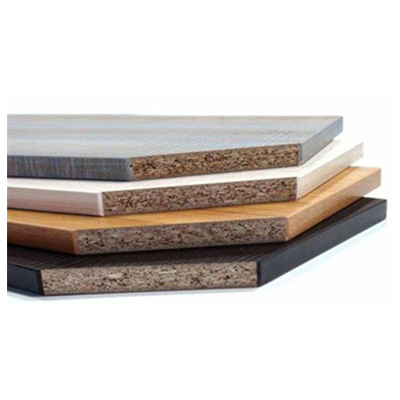
Particle board, also known as chipboard or low-density fiberboard, is an engineered wood product manufactured from wood chips and a synthetic resin or another suitable binder, which is pressed and extruded.[1] Particle board is often confused with oriented strand board (OSB) (also known as flakeboard, or wafer board), a different type of fiberboard that uses machined wood flakes and offers more strength.
Particle boards are cheaper, denser, and more uniform than conventional wood and plywood and are substituted for them when the cost is more important than strength and appearance. Particleboard can be made more appealing by painting or the use of wood veneers on visible surfaces. Though it is denser than conventional wood, it is the lightest and weakest type of fiberboard, except for the insulation board. Medium-density fiberboard and hardboard, also called high-density fiberboard, are stronger and denser than particleboard. Different grades of particleboard have different densities, with higher density connoting greater strength and greater resistance to failure of screw fasteners.
A significant disadvantage of particleboard is its susceptibility to expansion and discoloration from moisture absorption, particularly when it is not covered with paint or another sealer. Therefore, it is rarely used outdoors or in places where there are high levels of moisture, except in bathrooms, kitchens, and laundries, where it is commonly used as an underlayment shielded beneath a moisture-resistant continuous sheet of vinyl flooring.
In dry environments, veneered particleboard is preferred over veneered plywood because of its stability, lower cost, and convenience.
Reviews
There are no reviews yet.